
 English
 русский
 Français
 Español
 Português
 عربى

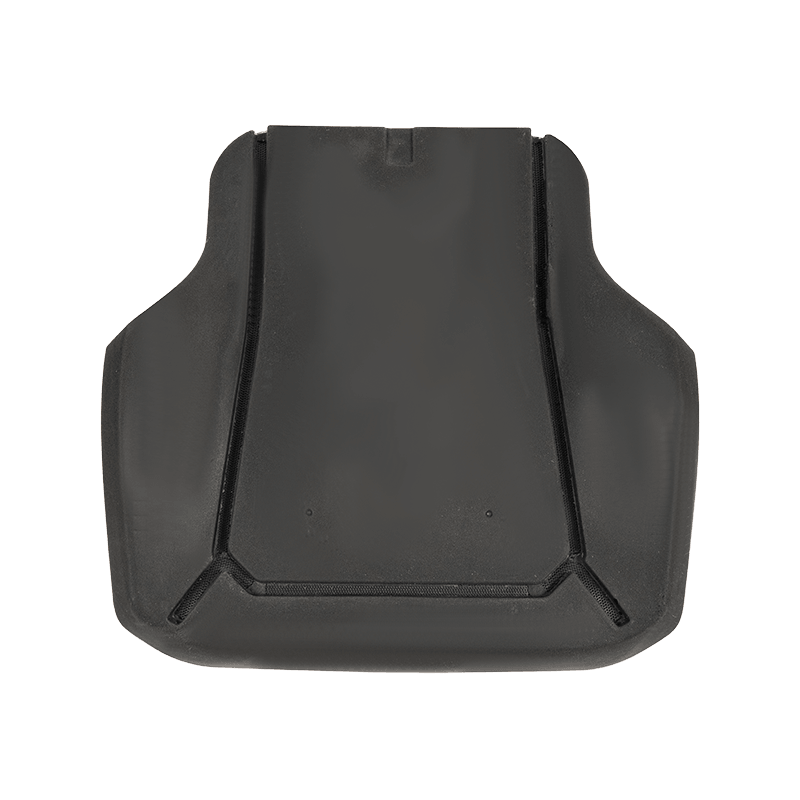
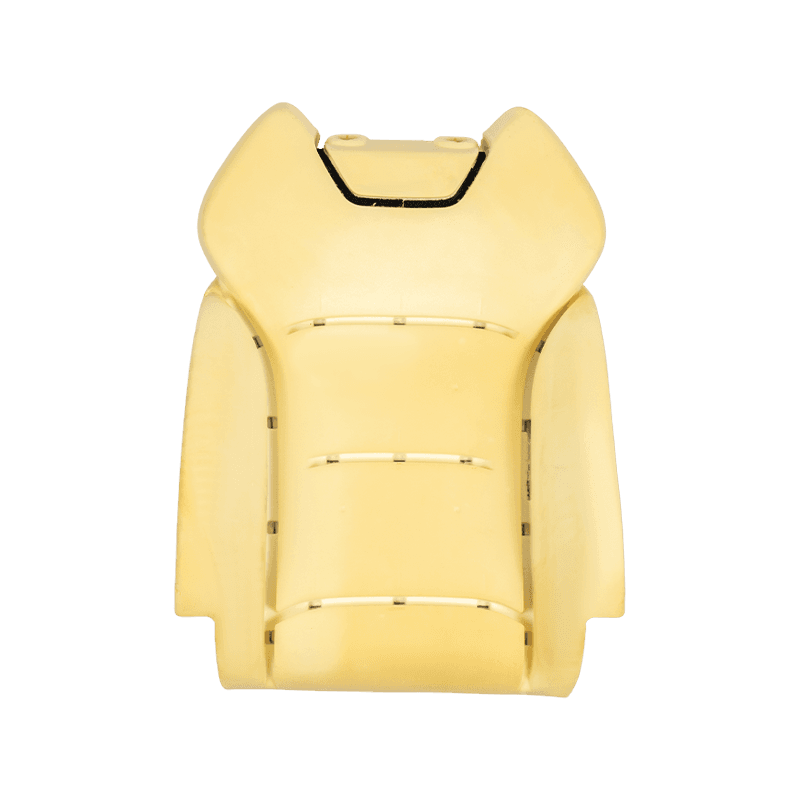
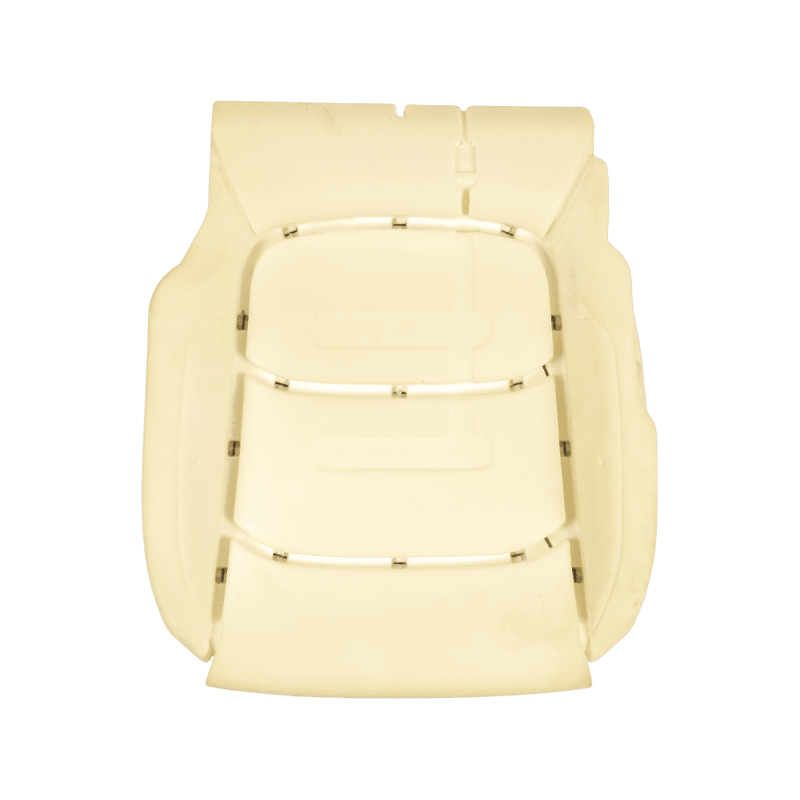
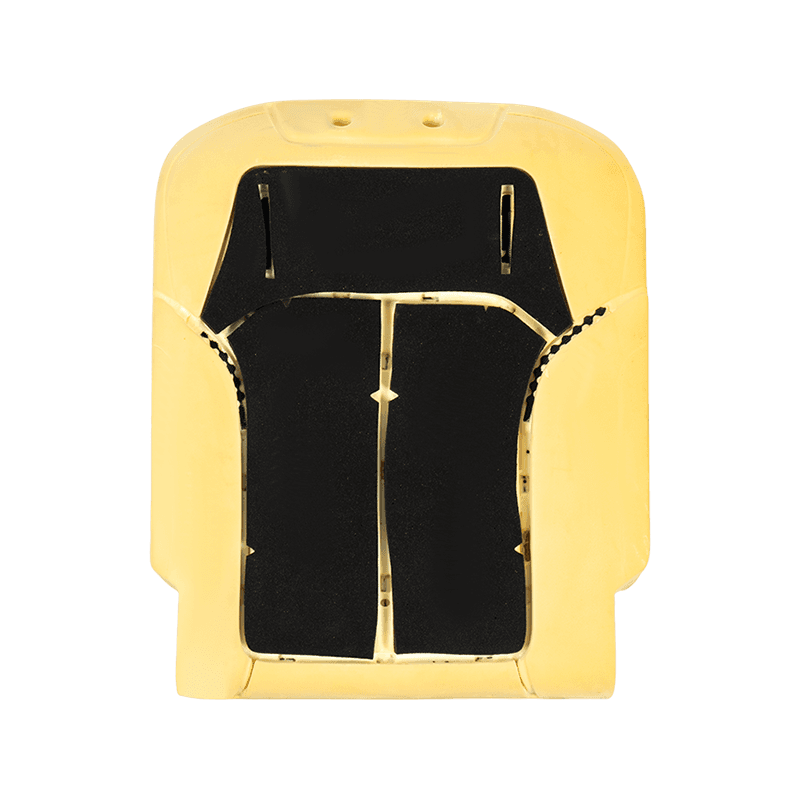
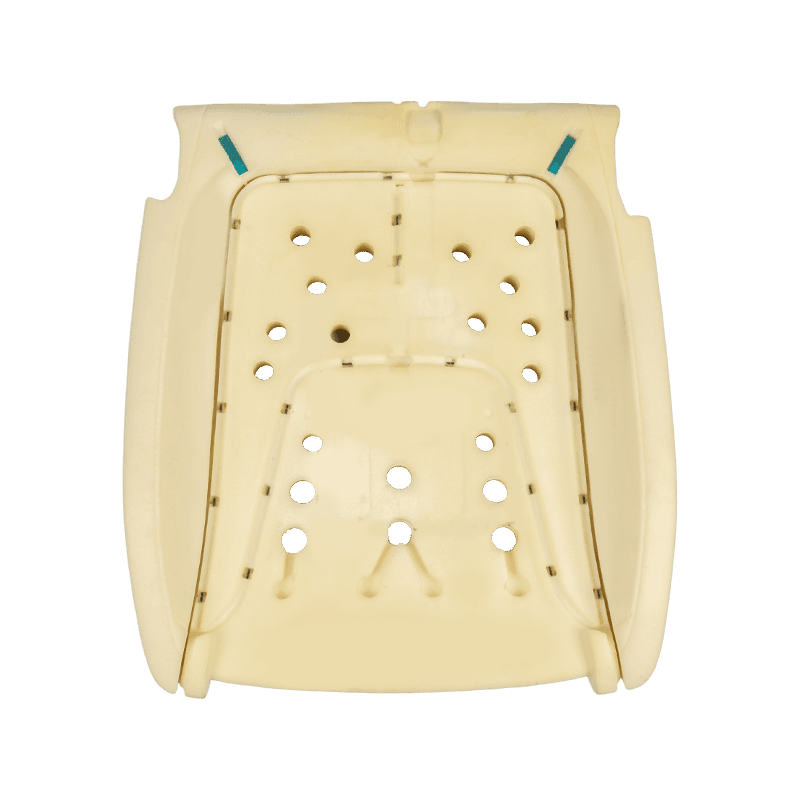
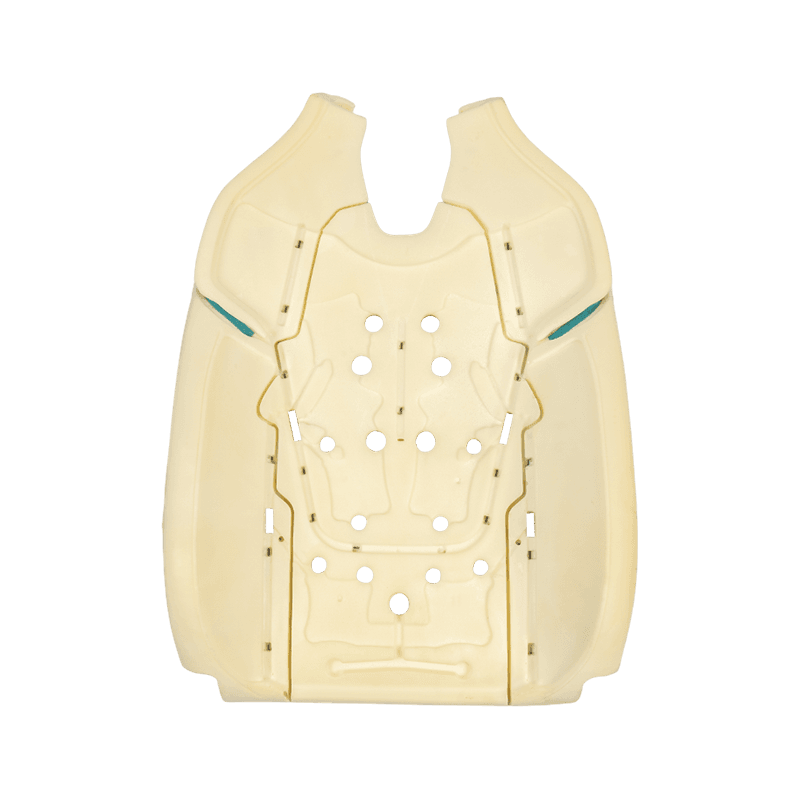

Automotive Molded Seat Foam from Zhoushan Jinxin Auto Parts Co., Ltd.
Zhoushan Jinxin Auto Parts Co., Ltd. is a China-based manufacturer of polyurethane foam, seat frames, and headrest frames for automotive seating. Established in 2000, we specialize in cold-cure molded foam components used as seat cushions, backrest cores, and ventilated foam assemblies. Our customers include Dongfeng, Lear, Geely, and other global OEMs, with annual sales of approximately RMB 150 million. As automotive molded seat foam manufacturers, we combine formulation engineering, mold design, multi-density molding, and dimensional inspection to deliver repeatable seat comfort components for vehicle programs.
Our high density auto seat foam factory produces components designed for driver seats, front passenger seats, rear seating, commercial vehicles, and specialty vehicle seating projects. The molded foam range includes high-resilience black polyurethane foam cores for ventilated driver seats, one-piece backrest foam cores, cushion foam cores, and dual-density cushion and backrest assemblies. We also support custom automotive molded seat foam factory programs with OEM/ODM development that can be coordinated with seat frames, headrest frames, and complete seat assembly projects.
Cold-Cure Molded Polyurethane Foam Technology
Automotive molded seat foam is the core comfort and support layer positioned between the seat frame and the outer surface finish. Its main functions include pressure distribution, vibration absorption, contour support, and long-term shape retention. At our factory, these foam parts are produced using polyurethane cold-cure molded foaming. Two main components, polyol and isocyanate, are mixed in precise proportions and injected into a closed mold preheated to 50–65°C. The foaming reaction and cross-linking cure take place inside the mold, and the finished part is demolded after a 4–8 minute molding cycle.
Formulation design is the key to tailoring each foam core for its application. The molecular weight and functionality of the polyol influence cross-linking density and elasticity. Grafted polyether polyol, also known as polymer polyol, determines hardness and load-bearing capacity. The catalyst system, typically a combination of amine and tin catalysts, controls the balance between foaming and gel reactions. Blowing agents, chemical or physical, affect the foam density and internal cell structure. This allows our engineering team to adjust softness, support, memory, and recovery according to seat requirements.
Modern seat foam has moved from single-density, single-hardness parts to multi-density zoning technology. Using a multi-channel mixing head, different reaction mixtures can be injected into selected areas of the same mold. This creates a gradient hardness distribution, for example a soft cushion center at 38–45 kg/m³ and firmer side bolsters at 55–65 kg/m³, without adhesive assembly or subsequent bonding. Dual-density molded foam is widely used in front seat cushions and backrests where body contouring and lateral support are both required.
Automotive Molded Seat Foam Product Range
Our molded foam product range includes the following representative seat foam cores and assemblies, each produced with polyurethane cold-cure molding and available for custom engineering:
- Automotive High-Resilience Black Polyurethane Foam Core for Ventilated Driver Seats
- Automotive Molded Polyurethane Backrest Foam Core for Driver Seats
- Automotive Molded Polyurethane Cushion Foam Core for Driver Seats
- Automotive Ventilated Dual-Density Polyurethane Seat Cushion Foam Core Assembly
- Automotive Front Dual-Density Polyurethane Seat Cushion Foam Core Assembly
- Automotive Front Dual-Density Polyurethane Seat Backrest Foam Core Assembly
| Product family | Typical application | Functional characteristic |
|---|---|---|
| High-Resilience Black Polyurethane Foam Core for Ventilated Driver Seats | Ventilated driver seat programs | High resilience foam core matched with airflow integration in the seating system |
| Molded Polyurethane Backrest Foam Core for Driver Seats | Driver seat backrest | One-piece molded backrest contour for lumbar and upper-body support |
| Molded Polyurethane Cushion Foam Core for Driver Seats | Driver seat cushion | Molded cushion geometry designed for repeated loading and occupant comfort |
| Ventilated Dual-Density Polyurethane Seat Cushion Foam Core Assembly | Ventilated front seat cushion | Dual-density comfort with ventilation channels in a single molded assembly |
| Front Dual-Density Polyurethane Seat Cushion Foam Core Assembly | Front seat cushion | Softer central zone and firmer side bolsters for pressure distribution and lateral support |
| Front Dual-Density Polyurethane Seat Backrest Foam Core Assembly | Front seat backrest | Dual-density backrest zoning for comfort and side containment |
Performance Parameters and Quality Control
Seat foam performance is evaluated through several mechanical and physical indicators. These indicators help ensure that the foam core maintains support over time, recovers after repeated loading, and withstands the stress of daily use. Key performance parameters for our molded seat foam parts include:
- Density: typically 38–65 kg/m³ depending on seat zone and required load capacity
- Resilience: greater than 60% for correct spring-back behavior
- Compression set: less than 7% under the relevant test conditions
- Tensile strength: greater than 150 kPa
- Tear strength: greater than 4.5 N/cm
Dimensional accuracy is also critical because seat foam must match the surrounding frame geometry, heating and ventilation components, trim cover, and adjustment mechanisms. In our production process, dimensional verification is supported by online 3D laser profile inspection after molding. This helps confirm that each cushion or backrest core stays within the intended contour before it moves to final assembly or shipping.
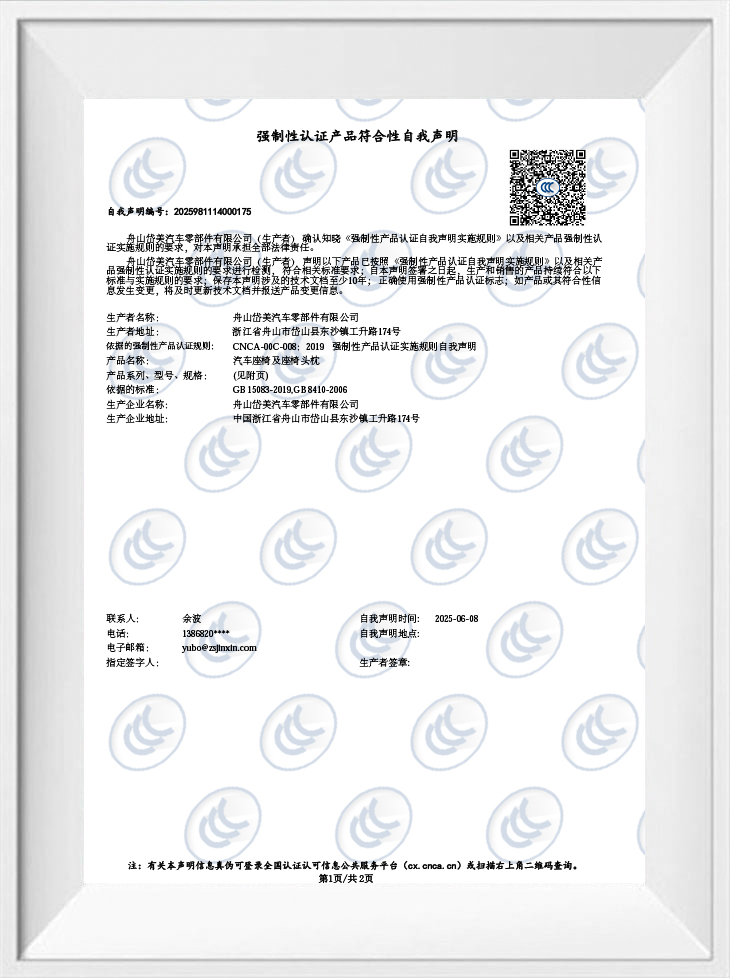
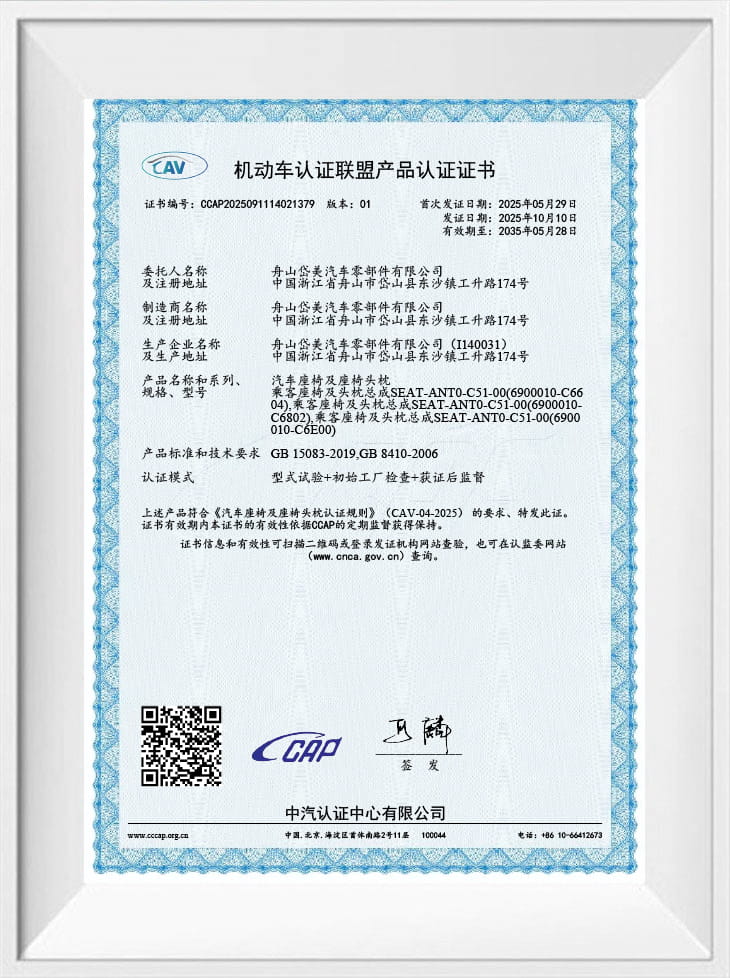
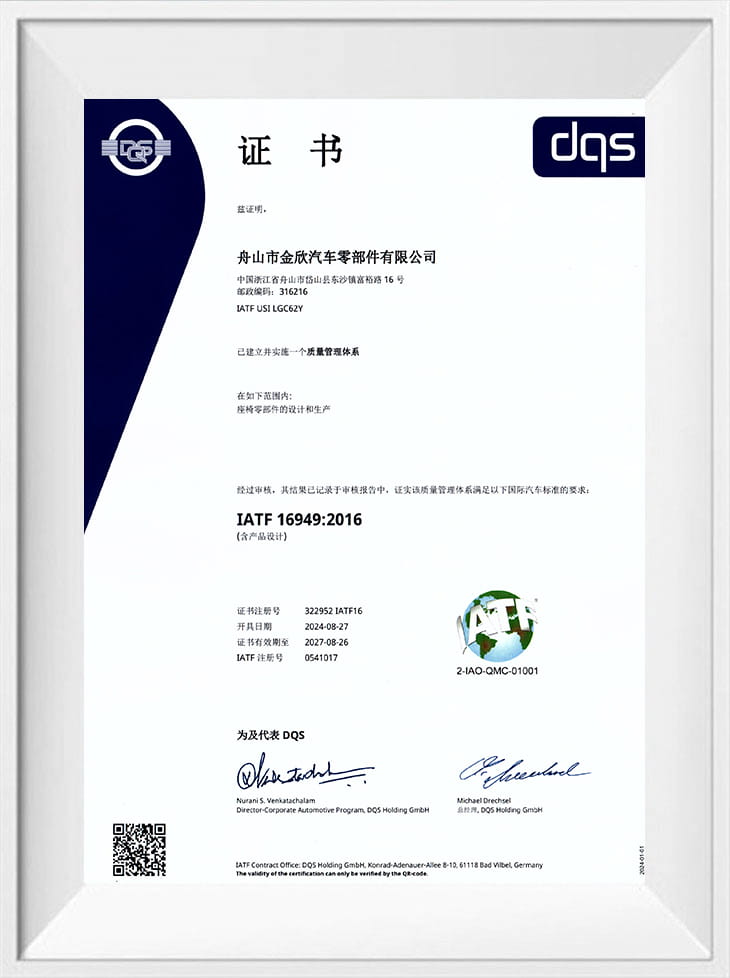
Zhoushan Jinxin Auto Parts Co., Ltd. holds IATF 16949:2016 for automotive quality management, CCC for China Compulsory Certification, and ISO 14001 for environmental management. These certifications support our supply of molded foam and other seating components to global automotive customers.
Environmental and Material Options
Automotive interior requirements increasingly focus on low-emission materials and sustainable production. We follow the main industry directions in molded foam material development, including low-VOC formulations, bio-based polyol substitution, and all-water foaming technology. These options can be applied when a seat program needs improved cabin air quality, reduced odor, or lower environmental impact.
Low-VOC formulations are designed for passenger vehicle interior environments where emissions from seat padding must remain within strict limits. Bio-based polyol substitution introduces renewable feedstock content into the polyurethane system. All-water foaming reduces the use of physical blowing agents and helps address sustainability targets. Material selection is always reviewed together with comfort, density, durability, and cost targets for the specific vehicle seat program.
Vehicle Applications and Seating System Integration
Our molded seat foam components are used across passenger car, electric vehicle, commercial vehicle, and specialty vehicle seating applications. The same molded foam technology can be adapted for driver seats, front passenger seats, rear seats, commercial vehicle driver seats, and vehicle-specific seating systems. Because our factory also produces seat frame assemblies, headrest assemblies, armrest frames, and complete seat assemblies, foam design can be coordinated with structural parts from the early development stage.
This is particularly important for ventilated seats. A ventilated foam core must allow airflow while maintaining comfortable pressure distribution and side support. Dual-density foam can be molded with optimized flow paths and supporting side bolsters without requiring separate components. For rear seats, foam cores can be arranged for split-fold configurations with defined break lines. For commercial vehicles, molded foam cores must tolerate long hours of continuous loading, high vibration input, and frequent adjustment by different drivers.
Custom Automotive Molded Seat Foam Development
Custom programs begin with the customer’s seat geometry, load envelope, comfort targets, and environmental specifications. Our engineering team then evaluates the required density range, resilience, compression set, tensile strength, and tear strength before defining the molding approach. If the seat requires a soft center and firmer bolsters, we apply multi-density zoning. If the vehicle program is built around ventilated seating, the foam core can be designed with airflow paths and compatible porosity. If cabin air quality targets are strict, low-VOC formulations are selected.
As an OEM/ODM manufacturer, we support the transition from part concepts to serial production. This includes mold design, trial molding, prototype evaluation, and process adjustment based on measured results. Because we also build seat frames and headrest mechanisms, the molded foam can be developed in parallel with the surrounding structure, reducing interface issues and assembly variation. Final parameters for each custom program, including dimensional tolerances and test requirements, are confirmed with the customer before serial delivery.
Frequently Asked Questions
Q1: What process is used to produce automotive molded seat foam?
A: We use polyurethane cold-cure molded foaming. Polyol and isocyanate are mixed in precise proportions and injected into a closed mold preheated to 50–65°C. The foam reacts and cures inside the mold, and the part is demolded after a 4–8 minute molding cycle.
Q2: How does dual-density foam improve seat comfort?
A: Dual-density molding creates a gradient hardness distribution in one part. A multi-channel mixing head injects different reaction mixtures into different areas of the same mold, producing a softer center zone and firmer side bolsters. This improves pressure distribution and lateral support without adhesive assembly.
Q3: What performance parameters are used to evaluate molded seat foam?
A: Density, resilience, compression set, tensile strength, and tear strength are the key indicators. Typical targets include density from 38 to 65 kg/m³, resilience greater than 60%, compression set less than 7%, tensile strength greater than 150 kPa, and tear strength greater than 4.5 N/cm.
Q4: Can molded seat foam be supplied together with seat frames and headrests?
A: Yes. Our manufacturing scope includes polyurethane foam, seat frames, headrest frames, armrest frames, and complete seat assemblies. Molded foam can be coordinated with structural parts, adjustment mechanisms, and trim integration for vehicle seat programs.
Q5: How are custom foam programs developed?
A: Custom programs start with part geometry, loading requirements, comfort targets, and environmental specifications. Our team reviews formulation, density zoning, mold design, and dimensional verification before serial production. Prototype evaluation and engineering validation are used to confirm that the foam meets the vehicle program requirements.
Summary
Zhoushan Jinxin Auto Parts Co., Ltd. supplies automotive molded seat foam as an established manufacturer of polyurethane foam components for vehicle seating. Our capabilities include cold-cure molding, multi-density zoning, online 3D laser dimensional inspection, IATF 16949:2016 certified quality management, CCC certification, and ISO 14001 environmental management. The molded foam range includes high-resilience black foam cores, driver backrest and cushion cores, ventilated dual-density cushion assemblies, and front dual-density backrest assemblies for passenger car, commercial vehicle, and specialty vehicle seating programs.
Since 2000, we have worked with global OEMs including Dongfeng, Lear, and Geely, combining foam formulation knowledge with seat frame and headrest manufacturing experience. Custom OEM/ODM programs are supported through geometry review, material selection, multi-density molding, prototype evaluation, and production tooling validation. Our molded seat foam development is focused on repeatable comfort, structural durability, environmental compatibility, and successful integration with the complete seat assembly.
