
 English
 русский
 Français
 Español
 Português
 عربى

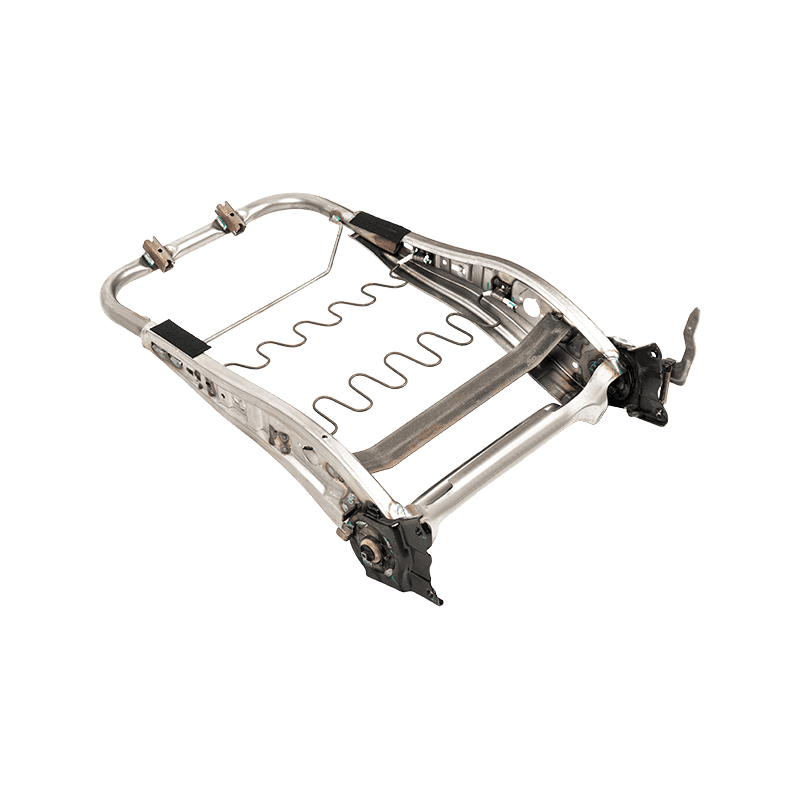
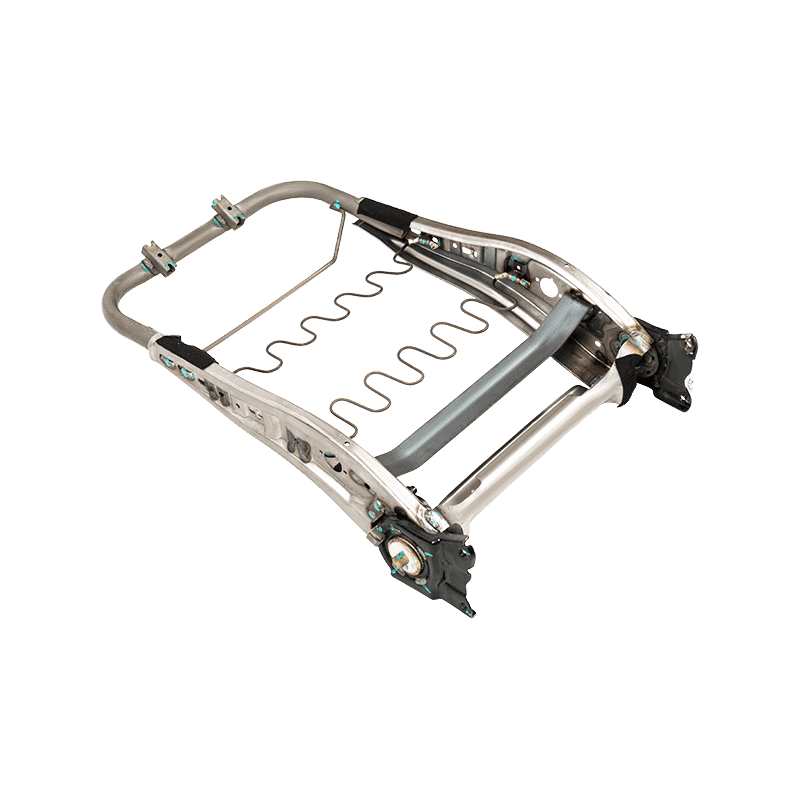
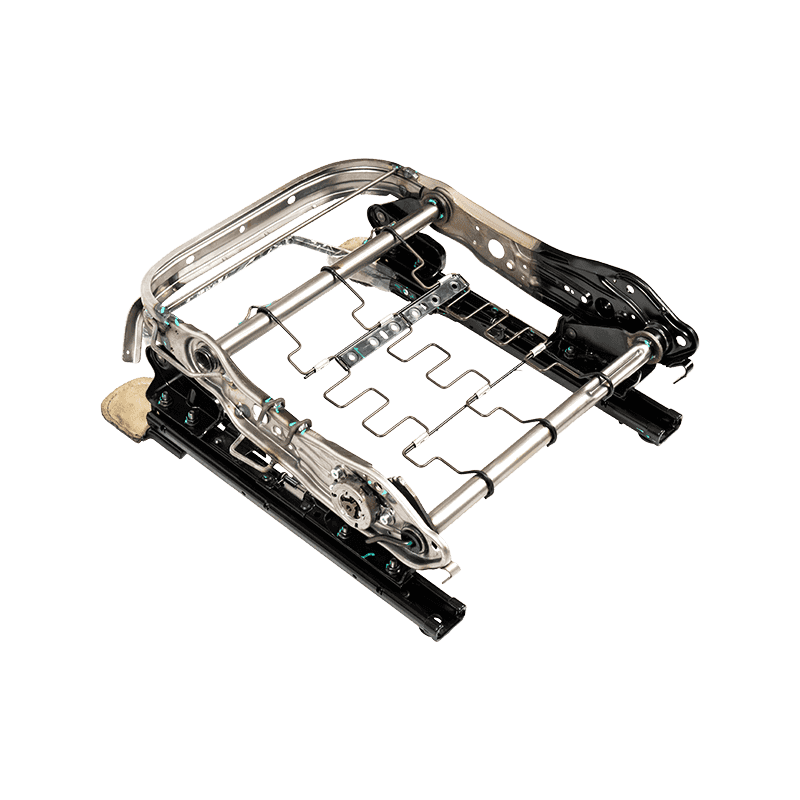
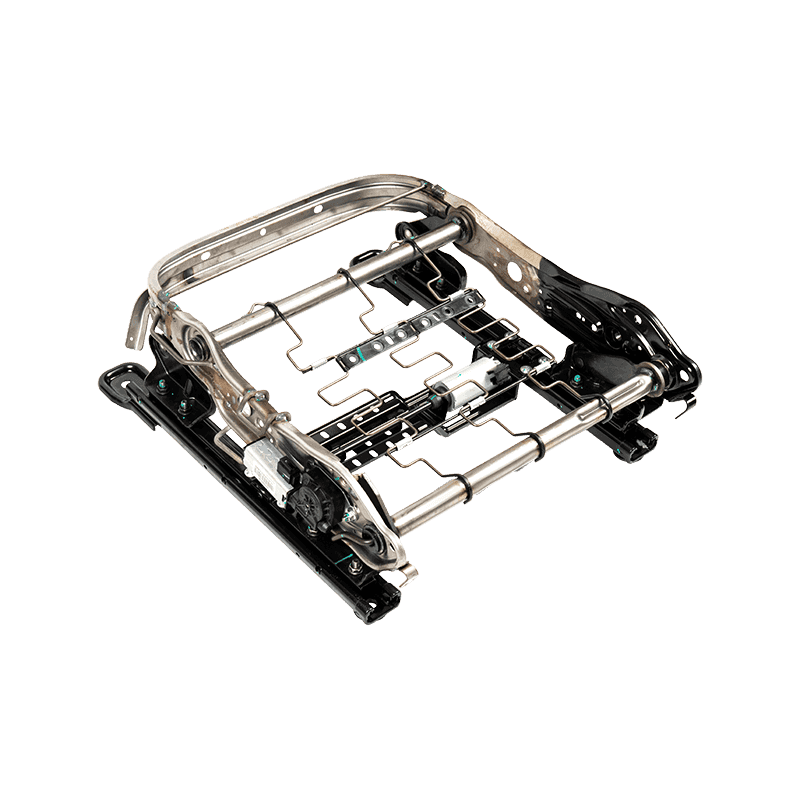

Seat Frame Assembly Manufacturer in China
Zhoushan Jinxin Auto Parts Co., Ltd. is a China-based automotive seat frame manufacturer and seat frame assembly factory established in 2000. We focus on the design, prototyping, and mass production of steel and multi-material seat frame assemblies for passenger cars, commercial vehicles, specialty vehicles, and off-road applications. Our manufacturing operation covers polyurethane foam, seat frames, armrest frames, headrest frames, and complete seat adjustment mechanisms. We supply Dongfeng, Lear, Geely, and other global OEMs, and our annual sales exceed RMB 150 million.
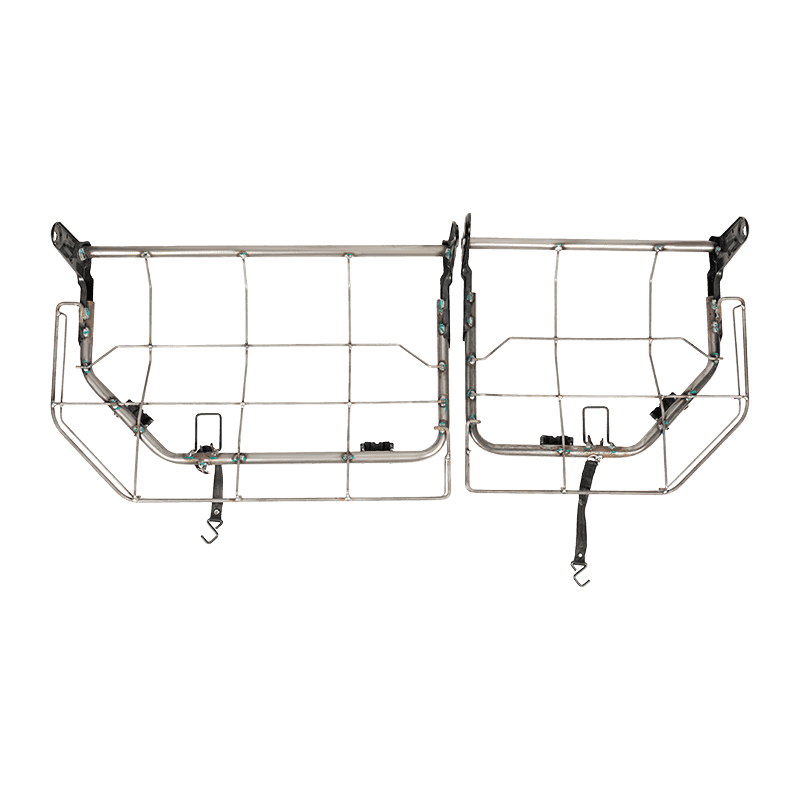
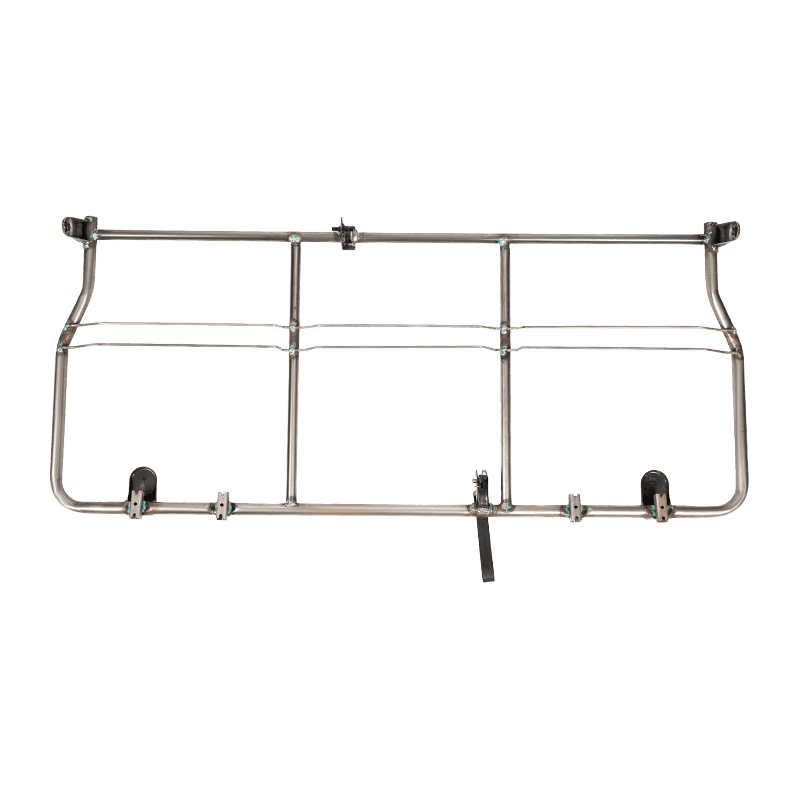
Buyers searching for China adjustable car seat frame manufacturers need a supplier that can manage both structural performance and precise adjustment integration. Our seat frame assembly product line includes manual reclining backrest frames, electric adjustable backrest frames, manual height-adjustable cushion frames, power cushion frames with integrated slide rails, rear split cushion frames, rear backrest frames, armrest support frames, and headrest internal frames. Each assembly is engineered to transfer occupant loads to the vehicle floor, maintain survival space during collisions, and provide stable mounting interfaces for all adjustment mechanisms and safety devices.
Adjustable Car Seat Frame Solutions
As a power seat frame assembly factory, we supply structural frames for both manual and powered adjustment systems. Our engineering team designs frames around the complete motion envelope of the seat: fore-aft slide, height adjustment, cushion angle, backrest reclining, and headrest positioning. We consider not only mechanism travel but also load paths, bracket orientation, wiring channels, and integration with vehicle floor interfaces.
For manual systems, we produce reclining backrest frames, height-adjustable cushion frames, and 60/40 split rear seat cushion frames. For powered systems, we manufacture electric backrest frame assemblies and power front seat cushion frame assemblies with integrated slide rails. These frames accept electric motor brackets, gearboxes, wire harness routing clips, and seat occupancy sensors. Our team works with your drawings or performance specifications to finalize bracket locations, fastening points, and structural reinforcements before tooling development.
- Manual front seat frames: backrest reclining and cushion height adjustment
- Electric front seat frames: backrest angle, cushion height, and slide rail integration
- Rear seat frames: 60/40 split cushion frames and complete backrest frames
- Armrest frames: rear center armrest load-bearing structures and front side armrest support frames
- Headrest frames: adjustable, folding, and multi-angle internal frame assemblies plus chrome-plated stay rods
Multi-Material Frame Engineering
Modern seat frame design requires a balance between strength, weight, and cost. We apply a multi-material hybrid design strategy to meet these conflicting objectives. Primary load paths, including backrest side plates, recliner brackets, and front slide rail interfaces, are manufactured from high-strength low-alloy steel QSTE500 using hot stamping and press-hardening processes. This approach achieves tensile strength exceeding 600 MPa while maintaining elongation of more than 15%.
For lateral support structures and upper backrest bridging elements, we use aluminum alloy 6061-T6 extruded profiles. These profiles provide high specific stiffness at roughly one-third the density of steel, reducing overall frame mass without sacrificing side-impact strength. For complex components such as the seat pan, we employ magnesium alloy AM60B integral die-casting. This technique integrates six to eight traditional stamped steel parts into a single casting, with wall thickness transitioning from 2.8 mm in structural zones to 1.5 mm in non-structural zones. The casting also incorporates wiring channels, connector clips, and ventilation fan mounts, reducing twelve fasteners and three welding processes.
Dissimilar materials are joined using crash-stable structural epoxy adhesives, achieving lap shear strength exceeding 25 MPa while eliminating the risk of electrochemical corrosion. When required, laser welding, self-piercing riveting, and structural bonding are combined to address thermal deformation and corrosion concerns across mixed-material interfaces.
Manufacturing and Dimensional Control
Our production process covers stamping, welding, adhesive bonding, surface treatment, and final assembly. After welding and joining, each complete frame assembly undergoes CMM dimensional verification at 47 critical measurement points. Statistical process control is applied throughout production, with CpK values consistently maintained above 1.67. This ensures that bracket positions, hinge axes, and slide rail interfaces remain repeatable across high-volume production runs.
For long-term durability, frame assemblies are validated through fatigue testing exceeding 200,000 cycles without crack initiation under 1.5 times the design load. The complete validation system also includes static strength testing with forward loading exceeding 20 kN, dynamic crash simulations, and more than 500 hours of salt spray corrosion testing. These tests confirm that our frames maintain dimensional stability, structural integrity, and surface protection under severe service conditions.
Seat Frame Assembly Product Series
| Product Series | Adjustment Type | Frame Architecture | Typical Application |
| Manual Reclining Front Seat Backrest Steel Frame Assembly | Manual backrest angle | High-strength steel QSTE500 side plates, hinge brackets | Passenger vehicles, pickup trucks |
| Electric Adjustable Front Seat Backrest Steel Frame Assembly | Electric backrest angle | Steel primary structure with motor bracket mounts | Passenger vehicles, commercial vehicles |
| Manual Height-Adjustable Front Driver Seat Cushion Steel Frame Assembly | Manual cushion height | Steel pan with height-adjustment mechanism | Driver seats in passenger and light commercial vehicles |
| Power Front Seat Cushion Steel Frame Assembly with Integrated Slide Rail | Power cushion positioning + slide rail | Steel frame, integrated rail interface, motor mounting points | Electric and premium vehicle front seats |
| Automotive Rear 60/40 Split Seat Cushion Steel Frame Assembly | Folding / fixed rear cushion | Steel frame with 60/40 split architecture | Passenger vehicle rear seats |
| Automotive Rear Backrest Steel Frame Assembly | Fixed or folding backrest | Steel frame with latch interfaces | Passenger vehicle rear seats |
| Armrest Internal Load-Bearing Frame Assembly | Fold-down or fixed armrest | Steel reinforcement for rear center and front side armrests | Passenger car front and rear seat armrests |
| Headrest Internal Frame Assembly and Stay Rod | Adjustable, folding, multi-angle | Steel frame, chrome-plated stay rods | Front and rear seat headrest systems |
Applications Across Vehicle Categories
Our seat frame assemblies are used across multiple vehicle segments. In the passenger vehicle segment, we supply front and rear seat structures for sedans, SUVs, pickup trucks, and electric vehicles. These frames are designed to accept side airbag brackets, seat belt pre-tensioner anchor points, and occupant classification sensors. We can adapt frame platforms to different floor interfaces and electrical architectures, helping OEMs reduce integration time.
In the commercial vehicle segment, our frames support driver seats, passenger seats, and sleeper applications. Heavy-duty driver seats require additional vibration damping and higher structural strength, and our frame designs accommodate air suspension base plates and hydraulic damping systems. We also produce bunks and sleeper structures for heavy truck cabins.
For specialty vehicles, the same engineering team develops reinforced frames with blast-mitigating energy-absorbing mechanisms, using armor-grade steel and controlled deformation structures. For ATV and off-road vehicles, we design compact frames with corrosion-resistant finishes suitable for exposure to water, mud, and extreme temperatures. This range of experience gives our customers a single development partner for diverse seating platforms.
OEM/ODM Project Support
We operate as an OEM/ODM manufacturing partner for global seat system integrators, vehicle manufacturers, and distributors. At the start of a project, our engineering team reviews the seat package dimensions, load requirements, adjustment travel, mounting interfaces, and applicable vehicle safety targets. From this information, we propose frame architecture, material grades, joining methods, weld specifications, and surface treatment options.
Prototyping is handled in our facility, followed by dimensional measurement and internal testing. Once the design is approved, we move to production tooling, process qualification, and pilot builds. We can also support customers who need complete seat assemblies with foam padding and trim covers, because our scope includes molded foam and seat assembly lines. This combined capability simplifies sourcing for customers looking for China adjustable car seat frame manufacturers and a power seat frame assembly factory in one qualified supplier.
For each project, we define specific inspection methods, dimensional targets, and validation tests together with the customer. Final validation plans are confirmed before mass production begins. Where standards or test procedures are not provided by the customer, our team references automotive industry practice and discusses the specifics with the customer before locking the plan.
Quality Certifications
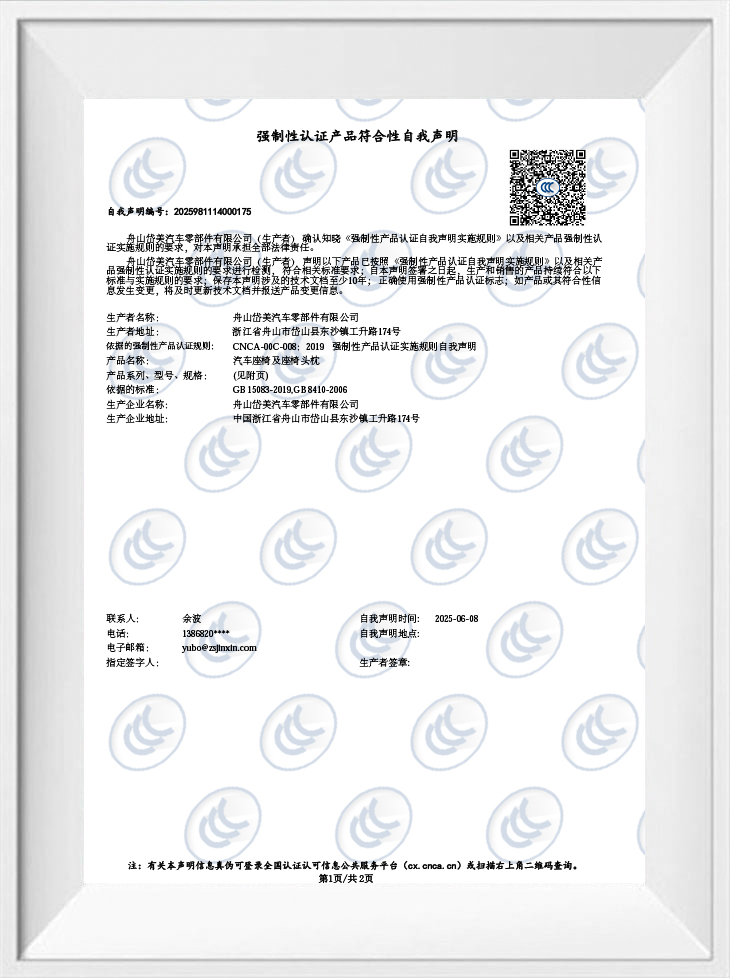
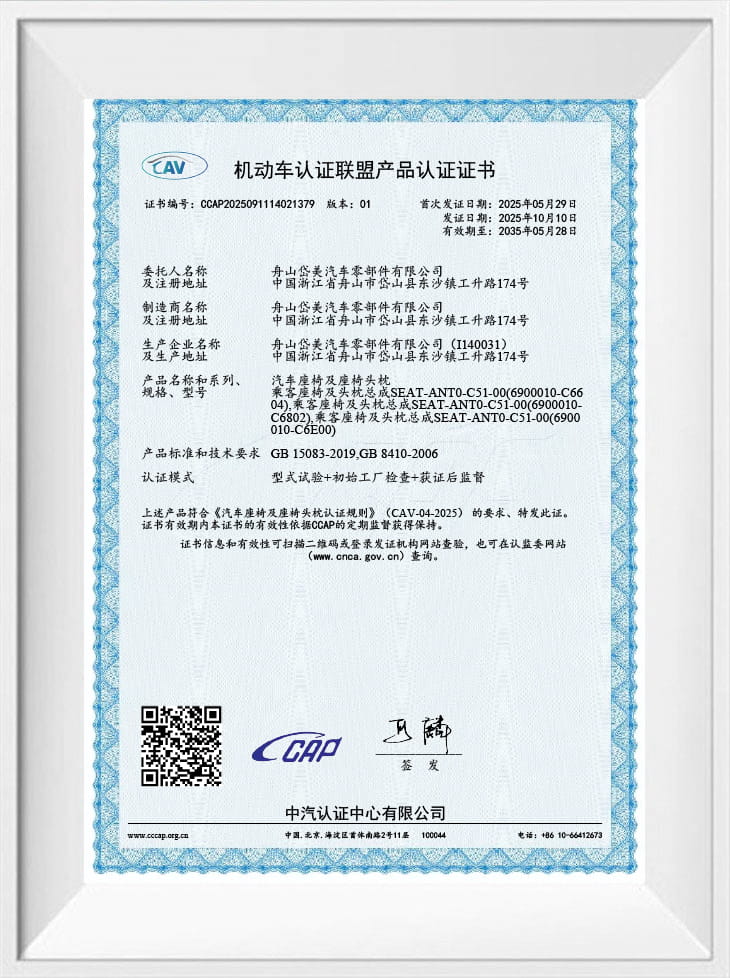
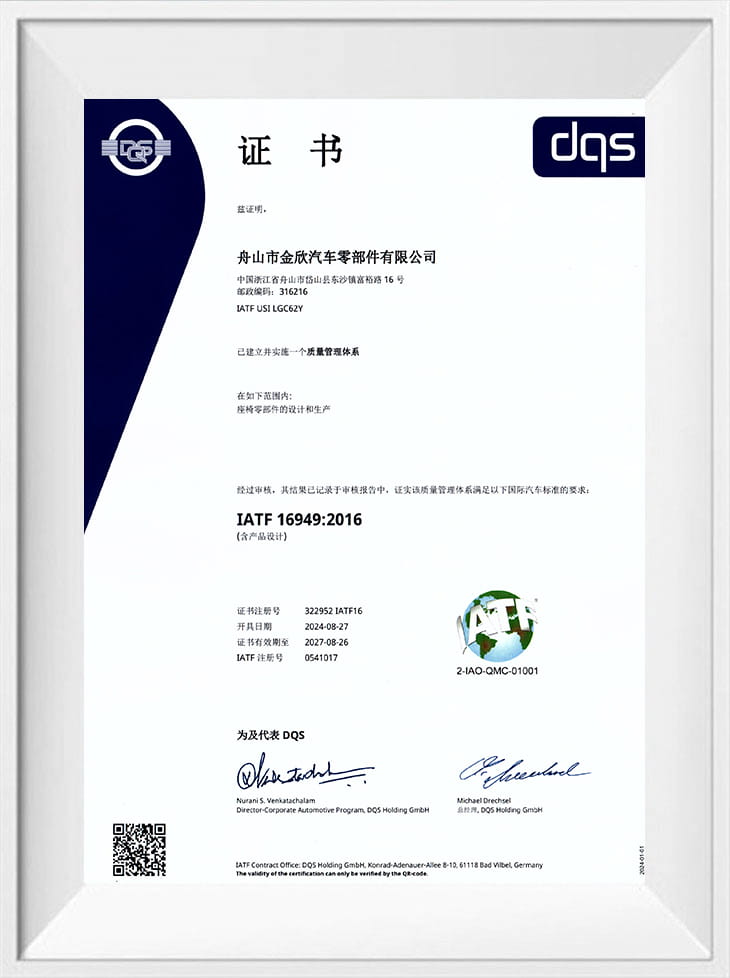
We maintain IATF 16949:2016 certification for automotive quality management, CCC certification for China Compulsory Certification, and ISO 14001 certification for environmental management. These systems govern our supplier management, production control, traceability, internal audits, and corrective action processes. Customers are welcome to review our certificates during the supplier qualification phase.
Frequently Asked Questions
Can you produce custom adjustable seat frames for a new vehicle program?
Yes. As an OEM/ODM manufacturer, we develop custom frame assemblies based on the customer's package drawings, seat performance specifications, and target weight. Our engineering team proposes the frame architecture, material grade, and adjustment system layout, then supports prototyping and production validation. Specific details such as bracket positions and weld interfaces are agreed with the customer before tooling.
What adjustment types are available in your seat frame assemblies?
We produce manual and electric frame assemblies. Manual systems include backrest reclining, cushion height adjustment, and rear seat folding structures. Electric systems include backrest angle adjustment and power cushion positioning with integrated slide rails. Headrest frames support height adjustment, folding, and multi-angle positioning.
Which materials do you use for seat frame assemblies?
Our standard frame program uses high-strength low-alloy steel QSTE500 for primary load paths, aluminum alloy 6061-T6 extruded profiles for lateral structures, and magnesium alloy AM60B die-cast parts for complex components such as seat pans. Dissimilar materials are joined with crash-stable structural epoxy adhesives to avoid electrochemical corrosion.
What testing is performed on frame assemblies?
Our validation includes static strength testing with forward loading exceeding 20 kN, dynamic crash simulation, fatigue testing exceeding 200,000 cycles under 1.5 times the design load, and more than 500 hours of salt spray corrosion testing. CMM dimensional verification is performed at 47 critical points, with SPC maintaining CpK values above 1.67.
What information should we provide when requesting a quote?
Please share the seat package drawing, target adjustment travel, vehicle floor interface, applicable safety requirements, and estimated annual volume. If available, include a reference frame sample or previous design. These details let our engineers confirm material selection, joining methods, and testing scope before providing a structured quotation.
Discuss Your Seat Frame Project With Our Team
If you are evaluating seat frame suppliers for a new vehicle program, send us your drawings and performance targets. Our engineers will review the package and recommend the most appropriate frame architecture and adjustment system. Contact us through the factory inquiry desk to begin the conversation.
Contact Us